
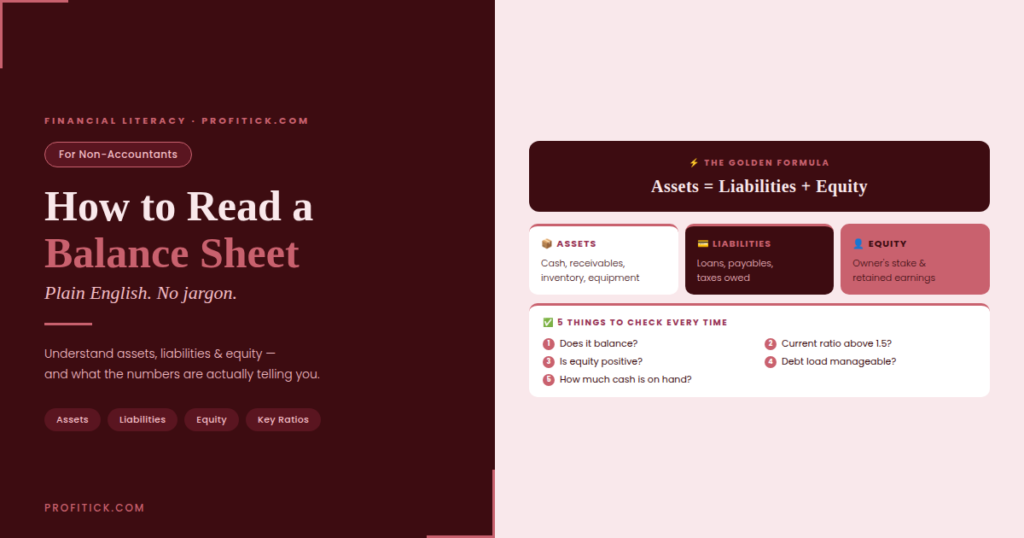
Never read a balance sheet before? This plain-English guide breaks down every section — assets, liabilities, equity — so any business owner or beginner can understand it in minutes.
Table of Contents
- What Is a Balance Sheet?
- Why Does a Balance Sheet Matter?
- The 3 Main Sections of a Balance Sheet
- Assets Explained
- Liabilities Explained
- Equity Explained
- The Golden Formula
- How to Actually Read One: A Simple Example
- 5 Things to Look for When Reading a Balance Sheet
- FAQs
Quick Answer
A balance sheet is a financial snapshot of a business at a specific point in time. It shows what the business owns (assets), what it owes (liabilities), and what’s left over for the owner (equity). The core rule: Assets = Liabilities + Equity. Once you understand that one equation, everything else falls into place.
Honestly? When I first started studying accounting, balance sheets confused me too. And I was working toward my CA designation at the time — so if they felt overwhelming to me at first, I completely understand why they feel that way to someone who didn’t choose accounting as a career.
But here’s what I’ve learned after years of working with financial statements professionally: a balance sheet is not complicated once someone walks you through it without the jargon. The numbers make sense. The structure is logical. And once it clicks, it clicks for good.
Whether you own a small business, you’re a newcomer trying to understand how Canadian companies manage their finances, or you’re a student just getting started — reading a balance sheet is one of the most practical financial skills you can build. This guide breaks it down simply, clearly, and in plain English. No formulas you need a finance degree to understand. Just the real story behind the numbers.
What Is a Balance Sheet?
A balance sheet is one of the three core financial statements every business produces. The other two are the income statement and the cash flow statement — but the balance sheet is often called the most important of the three, because it gives you the clearest picture of a business’s overall financial health at any given moment.
Think of it this way: if a business were a person, the income statement would tell you how much they earned last month. The balance sheet would tell you their entire financial situation right now — what they own, what they owe, and what they’re actually worth.
It’s called a “balance” sheet because both sides of it must always be equal. Whatever a business owns has to be funded either by borrowed money or by the owner’s own investment. Always. Without exception.
Balance sheets are used by business owners to understand their financial position, banks to decide whether to approve a loan, investors to evaluate whether a company is worth putting money into, and accountants and bookkeepers to prepare accurate financial reports.
Why Does a Balance Sheet Matter?
Here’s something I’ve seen happen more than once with clients: a business looks perfectly healthy on the surface — good revenue, steady customers, no obvious problems. Then a slow month hits, or an unexpected expense comes up, and suddenly there’s not enough cash to cover basic bills.
In almost every case, the warning signs were right there on the balance sheet. They just weren’t being looked at.
A balance sheet answers the questions that actually matter day to day. Can this business pay its bills if something goes wrong? Is it carrying too much debt? How much is the owner’s stake actually worth? Is the business building value over time or slowly losing it?
The income statement doesn’t tell you that story. The balance sheet does. For small business owners especially, reviewing it regularly — even once a quarter — can help you catch problems before they turn into real financial stress.
The 3 Main Sections of a Balance Sheet
Every balance sheet, whether it’s for a tiny sole proprietorship or a large corporation, is built around three sections:
1. Assets — Everything the business owns or is owed
2. Liabilities — Everything the business owes to others
3. Equity — What’s left over for the owner after liabilities are subtracted from assets
That’s it. Three sections. Everything else is just detail within those three. Once you know where to look and what each section is telling you, reading a balance sheet becomes straightforward.
Assets Explained
Assets are anything of value that the business owns or controls. They’re split into two categories based on how quickly they can be converted to cash.
Current Assets
Current assets are expected to be used or converted to cash within the next 12 months. Cash comes first here — it’s simply what’s sitting in the business bank account right now. After that, accounts receivable is the money customers owe you but haven’t paid yet. Inventory is products on hand ready to sell, and prepaid expenses are things you’ve already paid for in advance, like an annual insurance premium.
Non-Current Assets
These are assets the business holds and uses for longer than a year. Things like office equipment, vehicles, and machinery fall here, as do intangible assets like trademarks or software licences, and any long-term investments the business holds.
Why this matters in practice: A business with strong current assets relative to its current liabilities can pay its short-term bills without breaking a sweat. A business that’s heavy on long-term assets but thin on cash can run into serious trouble even when it looks profitable on paper — something I’ve seen trip up more than a few small business owners.
Liabilities Explained
Liabilities are everything the business owes to someone else — banks, suppliers, employees, the government. Like assets, they’re split into current and long-term.
Current Liabilities
These are debts due within the next 12 months. Accounts payable is money owed to suppliers you haven’t paid yet. Short-term loans are loan payments coming due within the year. Accrued expenses cover things like wages that have been earned by employees but not yet paid out. Taxes payable is what’s owed to the government.
Non-Current Liabilities
These are debts due after 12 months — long-term bank loans, mortgages on business property, and deferred tax liabilities that will come due in future years.
Why this matters: High liabilities relative to assets is a warning sign worth taking seriously. It means the business is heavily dependent on debt to operate. That’s manageable up to a point, but it becomes dangerous the moment revenue slows down or an unexpected cost arrives.
Equity Explained
Equity — also called owner’s equity, shareholders’ equity, or net worth — is what remains after you subtract all liabilities from all assets. It’s the owner’s actual financial stake in the business.
Equity typically includes the money the owner originally invested to start the business, retained earnings which are profits the business has kept over time instead of distributing, and drawings or dividends which is money the owner has taken out.
Why this matters: Growing equity over time means the business is building real value. Shrinking equity — and especially equity that has gone negative — is a serious red flag. It means the business owes more than it owns, and that situation needs attention from an accountant sooner rather than later.
The Golden Formula
Everything on a balance sheet ties back to one equation:
Assets = Liabilities + Equity
This is the accounting equation, and it must always balance — which is exactly where the name “balance sheet” comes from.
The logic behind it is simple: a business acquires assets in one of only two ways. Either it borrows money to buy them (liabilities) or it uses the owner’s own money (equity). Every single asset on the balance sheet was funded by one of those two sources — no exceptions.
If a business buys a $10,000 laptop with cash, assets go up $10,000 and cash (also an asset) goes down $10,000 — still balanced. If it buys on credit, assets go up $10,000 and liabilities go up $10,000 — still balanced. The equation never breaks. If your balance sheet doesn’t balance, something has been recorded incorrectly.
How to Actually Read One: A Simple Example
Here’s a simplified balance sheet for a fictional small Canadian service business — similar in structure to ones I work with regularly. The numbers are straightforward so you can follow the logic without getting lost in complexity.
MAPLE BOOKKEEPING CO. Balance Sheet — December 31, 2024
ASSETS
| Current Assets | Amount (CAD) |
|---|---|
| Cash | $12,000 |
| Accounts receivable | $8,500 |
| Prepaid expenses | $1,200 |
| Total Current Assets | $21,700 |
| Non-Current Assets | Amount (CAD) |
|---|---|
| Equipment | $15,000 |
| Less: Depreciation | ($3,000) |
| Total Non-Current Assets | $12,000 |
| TOTAL ASSETS | $33,700 |
LIABILITIES
| Current Liabilities | Amount (CAD) |
|---|---|
| Accounts payable | $4,200 |
| Taxes payable | $2,100 |
| Total Current Liabilities | $6,300 |
| Non-Current Liabilities | Amount (CAD) |
|---|---|
| Bank loan | $10,000 |
| Total Non-Current Liabilities | $10,000 |
| TOTAL LIABILITIES | $16,300 |
EQUITY
| Amount (CAD) | |
|---|---|
| Owner’s capital | $10,000 |
| Retained earnings | $7,400 |
| TOTAL EQUITY | $17,400 |
| TOTAL LIABILITIES + EQUITY | $33,700 ✓ |
What does this tell us?
The business has more assets than liabilities — a healthy sign. Current assets ($21,700) are well above current liabilities ($6,300), so paying short-term bills isn’t a concern. Equity is positive and growing, meaning the owner has real value built up in the business. And the bank loan ($10,000) is very manageable relative to total assets ($33,700).
If I were reviewing this for a client, I’d call this a clean, healthy balance sheet with nothing alarming — exactly what you want to see.
5 Things to Look for When Reading a Balance Sheet
Once you can navigate the three sections, here are the specific things worth checking every time you look at one.
1. Does it balance? Total assets must equal total liabilities plus equity. If they don’t, there’s a recording error somewhere that needs to be found and corrected before anything else.
2. Current ratio — can it pay short-term bills? Divide current assets by current liabilities. A ratio above 1.5 is generally healthy. Below 1.0 is a warning sign that short-term obligations may be hard to meet.
Current Ratio = Current Assets ÷ Current Liabilities Maple Bookkeeping example: $21,700 ÷ $6,300 = 3.4 — very healthy
3. Is equity positive and growing? Positive equity means the business has real value. Negative equity means debts exceed assets — a situation that almost always needs professional attention quickly.
4. How much debt is the business carrying? Compare total liabilities to total assets. If liabilities make up more than 60–70% of total assets, the business is heavily leveraged and more vulnerable to financial shocks.
5. What does the cash position look like? A business can show a profit on paper and still run out of cash. Always check the cash line — it tells you how much breathing room the business actually has right now, today.
The Bottom Line
Reading a balance sheet is not an accountant-only skill. It never was. It’s a financial literacy skill — and one that becomes genuinely useful the moment you’re running a business, making investment decisions, or simply trying to understand your own financial picture more clearly.
I was confused by balance sheets when I started out too. But once the three sections clicked and the equation made sense, it became one of the most natural things to read. That’s what I want for you after going through this guide.
Start with the structure. Learn the equation. Look at a real one — even your own if you have one. It will make more sense than you expect.
Already read this? Check out: Bookkeeping vs Accounting — What’s the Difference?
Disclaimer: This post is for informational and educational purposes only and does not constitute professional financial or accounting advice. Please consult a qualified accountant or CPA for advice specific to your situation.
About the Author: Anam Gul is a professional accountant with 6+ years of experience across Canada, the USA, and India. She holds an M.Com, B.Com, and is a QuickBooks Online Certified ProAdvisor currently pursuing her CA designation through ICAI. She writes at Profitick.com to make finance accessible to everyone.
FAQs
What is a balance sheet in simple terms? A balance sheet is a financial snapshot showing what a business owns (assets), what it owes (liabilities), and what the owner’s stake is worth (equity) — all at one specific point in time. Think of it as a photograph of a business’s financial health.
What are the 3 parts of a balance sheet? Every balance sheet has three sections: assets, liabilities, and equity. They’re connected by one rule — assets always equal liabilities plus equity. That equation is the foundation of all accounting.
What is the difference between a balance sheet and an income statement? An income statement shows revenue and expenses over a period of time — like a monthly or annual summary. A balance sheet shows the financial position of the business at one specific moment. One tells you how the business performed; the other tells you what it’s worth right now.
What does it mean if a balance sheet doesn’t balance? It means there is a recording error somewhere in the accounts. The equation Assets = Liabilities + Equity must always hold. If it doesn’t, an accountant or bookkeeper needs to find and correct the mistake before the statements can be relied on.
Can a small business owner read their own balance sheet? Absolutely — and they should. With a basic understanding of the three sections and the accounting equation, any business owner can read and interpret their own balance sheet. Most accounting software like QuickBooks Online generates one automatically so you don’t even need to build it from scratch.
What is a good current ratio on a balance sheet? A current ratio above 1.5 is generally healthy — it means the business has $1.50 in current assets for every $1.00 in current liabilities. Below 1.0 suggests the business may have difficulty meeting its short-term obligations.
How often should a small business review its balance sheet? At minimum, quarterly. Monthly is better. I always recommend business owners get into the habit of a quick monthly review — it takes 10 minutes and can catch problems early before they become serious.
What does negative equity on a balance sheet mean? Negative equity means total liabilities exceed total assets — the business owes more than it owns. It’s a serious warning sign and one of the first things I look for when reviewing a client’s financials. If you’re seeing negative equity, speak to an accountant as soon as possible.