
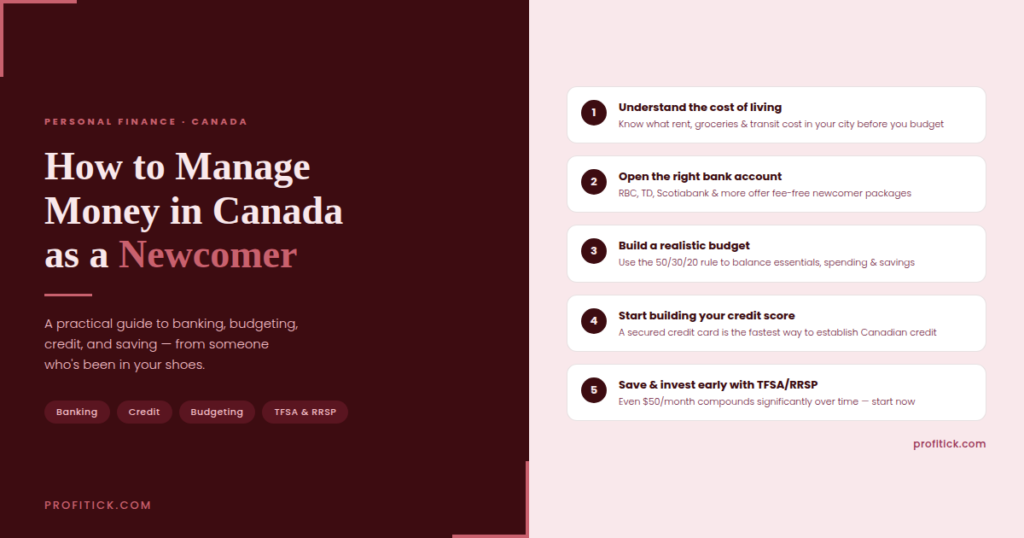
New to Canada? Learn how to open a bank account, build credit, budget, and start saving — practical money tips every newcomer needs from day one.
Table of Contents
- Understanding the Cost of Living in Canada
- Opening Your First Bank Account
- Creating a Budget That Actually Works
- How to Build Credit as a Newcomer
- Saving and Investing Early in Canada
- Common Financial Mistakes to Avoid
- FAQs
Quick Answer
Moving to Canada comes with a learning curve — especially when it comes to money. The most important steps newcomers should take early are opening a Canadian bank account, creating a realistic monthly budget, building credit through a secured card, and setting up even a small savings habit. Start simple, stay consistent, and things will come together faster than you expect.
Moving to a new country is one of the most exciting and overwhelming things a person can do. New city, new rules, new system — and a financial landscape that works completely differently from what you may be used to back home.
I know this firsthand. When I moved to Canada, I had to figure out everything from scratch: which bank to open an account with, what a credit score even means here, why landlords care about it so much, and how to stretch a budget while the Canadian dollar made everything feel expensive.
The good news? Managing money in Canada is very learnable. And if you get the basics right in your first few months, you’ll be in a much stronger position than most newcomers who figure it out the hard way.
This guide walks you through the most important steps — clearly, practically, and in the order that actually makes sense.
Understanding the Cost of Living in Canada
Before you can budget, you need a realistic picture of what things actually cost. Canada is a big country, and the cost of living varies enormously depending on where you settle.
A one-bedroom apartment in downtown Toronto or Vancouver will run you significantly more than the same apartment in Halifax, Winnipeg, or Regina. If you have flexibility in where you live, this is worth thinking about early.
Here’s a rough monthly estimate for a single person:
| Expense | Average Monthly Cost (CAD) |
|---|---|
| Rent (1-bedroom apartment) | $1,800 – $2,500 |
| Groceries | $350 – $600 |
| Public transportation | $100 – $160 |
| Utilities and internet | $150 – $250 |
| Cell phone plan | $40 – $70 |
| Miscellaneous (clothing, leisure) | $200 – $400 |
These are averages — your actual numbers will depend on your city, lifestyle, and choices. Websites like Numbeo and Rentals.ca let you compare real costs across Canadian cities, which is helpful when you’re still deciding where to plant roots.
The reason this matters: building a budget around assumptions instead of real numbers leads to shortfalls. Know your city’s costs before you commit to a lifestyle.
Opening Your First Bank Account
A Canadian bank account is one of the first things you’ll need — it’s how you receive your salary, pay rent, and manage everyday expenses. Without one, you’re working against yourself from day one.
Most newcomers use two types of accounts:
Chequing account — your everyday account for deposits, withdrawals, and bill payments. Comes with a debit card and online banking.
Savings account — where you set money aside. Earns a small amount of interest and is ideal for an emergency fund or future goals.
The five major Canadian banks all offer newcomer programs that remove some of the usual barriers — no Canadian credit history required, often no monthly fees for the first year:
- RBC — Newcomer Advantage program
- TD — New to Canada Banking Package
- Scotiabank — StartRight Program
- CIBC — Welcome to Canada Package
- BMO — NewStart Program
Spend a little time comparing them before you decide. Some include free international wire transfers, which matters if you’re sending money home. Others bundle a credit card offer that can help you start building credit right away — which brings us to the next section.
Creating a Budget That Actually Works
The word “budget” makes a lot of people defensive, as if it means cutting out everything fun. It doesn’t. A budget is simply a plan for your money — and without one, money tends to disappear in ways you can’t explain at the end of the month.
Here’s a simple way to start:
Step 1: List your fixed monthly costs — rent, phone bill, transit pass, insurance. These don’t change much.
Step 2: Estimate your variable costs — groceries, dining out, clothing, entertainment. These shift depending on your habits.
Step 3: Compare your total against your monthly income. If the numbers don’t add up, something needs to adjust.
A framework many people find helpful is the 50/30/20 rule:
- 50% of your take-home income goes to essentials (rent, groceries, transport)
- 30% goes to personal spending (dining, leisure, hobbies)
- 20% goes to savings or debt repayment
This isn’t a rigid rule — if your rent is unusually high, your percentages will look different. But it gives you a useful starting point.
For tools, you have good options at every level of effort. Mint and PocketGuard connect to your accounts and track spending automatically. YNAB (You Need A Budget) is more hands-on but works well for people who want more control. If you prefer simplicity, a basic Google Sheets spreadsheet does the job just as well.
The most important habit is not which tool you use — it’s reviewing your spending weekly, at least in the first few months, until you understand where your money is actually going.
How to Build Credit as a Newcomer
In Canada, your credit score is more than just a number. It determines whether you qualify for an apartment rental, a car loan, a mortgage, or even certain jobs. Landlords check it. Banks check it. Insurance companies check it.
Most newcomers arrive with no Canadian credit history at all — which isn’t the same as bad credit, but it does create friction. The goal is to start building a record as early as possible.
The best starting point: a secured credit card.
A secured card works exactly like a regular credit card, except you put down a deposit (usually $200–$500) as collateral. You use the card for small, regular purchases — groceries, a monthly subscription, gas — and you pay the full balance every month. After 6–12 months of consistent use, your credit score begins to build meaningfully.
A few habits that directly improve your score over time:
- Pay every bill on time — including your phone and utilities, not just credit cards
- Keep your credit card balance below 30% of your limit (if your limit is $500, don’t carry more than $150 in charges)
- Avoid applying for multiple credit products at once — each application creates a hard inquiry that temporarily lowers your score
Credit takes time. Most newcomers with consistent habits see a solid score within one to two years. The key is starting early rather than waiting until you “need” credit for something important.
Saving and Investing Early in Canada
Once your budget is stable and your credit habits are in place, the next focus is building wealth — starting with an emergency fund and moving toward long-term savings.
Emergency fund first. Before investing a single dollar, aim to save three to six months of essential living expenses. This is your financial cushion for unexpected situations: a job loss, a medical expense, a flight home for a family emergency. Without it, any disruption sends you straight to debt.
Once that’s in place, Canada offers two powerful savings and investment accounts that every newcomer should know about:
TFSA (Tax-Free Savings Account): Any interest, dividends, or investment growth inside a TFSA is completely tax-free. You can withdraw the money at any time without penalty. It’s highly flexible and works for both short-term goals (saving for a car) and long-term ones (building retirement savings).
RRSP (Registered Retirement Savings Plan): Contributions to an RRSP reduce your taxable income today, which lowers your tax bill. The money grows tax-deferred until retirement. Best used once your income is high enough that the tax deduction is meaningful.
For most newcomers starting out, the TFSA is the right first account. It’s simpler, more flexible, and doesn’t lock your money away.
You don’t need to start with large amounts. Even $50 or $100 a month, automated to transfer on payday, builds a meaningful habit and compounds over time. Apps like Wealthsimple and Questrade offer beginner-friendly investing with low fees and no minimum balance requirements — both are popular choices among newcomers getting started.
Common Financial Mistakes to Avoid
Most financial setbacks newcomers experience aren’t from bad luck — they’re from a handful of very common patterns. Being aware of them puts you ahead.
Relying too heavily on credit cards. Credit is a useful tool, but carrying a balance month to month is expensive. Canadian credit card interest rates are typically 19.99% or higher. Use credit for the rewards and the credit-building benefit — not because cash is running short.
Skipping insurance. Health coverage varies by province, and the provincial plan doesn’t cover everything. Dental, vision, prescriptions, and paramedical services usually require private or employer coverage. Renters insurance is inexpensive and covers your belongings against theft or damage — most newcomers skip it and regret it.
Not having an emergency fund. Life in a new country is unpredictable. A car repair, a missed paycheque, or an unexpected trip home can destabilize your finances completely if you have no buffer. Three months of expenses saved changes everything.
Building a budget once and never revisiting it. Expenses change. Income changes. A budget you set in your first month won’t reflect your life six months later. Review and adjust it quarterly at minimum.
Waiting too long to start saving. Every month you delay saving is a month of compound growth you don’t get back. Small, consistent contributions started early outperform larger contributions started late — consistently.
The Bottom Line
Managing money well in Canada isn’t complicated — but it does require getting the right foundations in place early. Open the right bank account, understand what things cost in your city, build a simple budget, start building credit, and set up a savings habit before you feel like you can afford to.
None of these steps require a lot of money to start. They require consistency and a little bit of financial awareness — both of which you now have.
Disclaimer: This content is for informational purposes only and does not constitute financial advice. Please consult a qualified financial advisor for guidance specific to your situation.
About the Author: Anam Gul is a professional accountant with 4+ years of experience across Canada, the USA, and India. She holds an M.Com, B.Com, and is a QuickBooks Online Certified ProAdvisor currently pursuing her CA designation and planning to pursue CPA in the near future. She writes at Profitick.com to make personal finance accessible to everyone.
FAQs
What is the best way to send money internationally from Canada? Online services like Wise (formerly TransferWise), Remitly, and Western Union typically offer better exchange rates and lower fees than banks for international transfers. Always compare rates before sending — they change daily.
Can I build credit in Canada without a job? Yes. A secured credit card doesn’t require employment — you provide a deposit as collateral. Make small purchases and pay the balance in full each month. Several major bank newcomer programs also offer starter credit cards with minimal requirements.
How much should I save each month in Canada? A common starting target is 10–20% of your monthly take-home income. If that’s not immediately possible, start with whatever amount you can automate and increase it gradually as your income grows.
Which bank is best for newcomers in Canada? All five major banks (RBC, TD, Scotiabank, CIBC, BMO) offer newcomer packages with fee waivers and easy account opening. Compare their current offers — features and perks change periodically, and the best choice depends on where you’ll be banking most.
Do I need a Canadian credit score right away? Not immediately, but starting early is strongly recommended. A credit score affects your ability to rent an apartment, get a phone plan without a deposit, qualify for loans, and in some cases, secure employment. The earlier you start building it, the sooner doors open.